- News
- lifestyle
- health-fitness
- fitness
- Rid yourself of all fears with rope Mallakhamb
Trending
This story is from September 25, 2012
Rid yourself of all fears with rope Mallakhamb
What have I got myself into? The moment I step into Shree Samartha Vyayam Mandir at Shivaji Park in Dadar, my confidence in my physical strength hits rock bottom.
I consider myself fit, thanks to years of intense Salsa dancing. But when I see six teenagers gracefully suspended several feet above ground, entangled in canvas covered ropes, I begin having serious doubts.

As we start, I realise why evolution equipped humans with the big toe. It functions like a second pair of hands when climbing up a rope.
To establish my relationship with my new found partner, Deshpande makes me climb all the way up to top. My biceps, triceps and core grow tense as I progress. Had I been scared or unfit, I would have been allowed to simply sit on the rope and swing.
“The basic idea is to take away fear and make you feel comfortable with the rope,” explains Deshpande. “Lift your left leg as high as you can and grab the rope with your big toe,” he instructs me while wrapping the rope around it. Using all my strength, I haul myself up. So far so easy, but now comes the
tricky part. “Swing your right leg up,” he says.
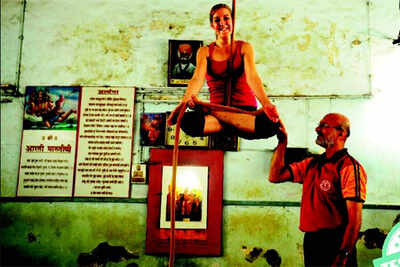
I kick away the rising feeling of uneasiness in my stomach and do as requested. Et voila! I’m hanging upside down, with my right toe gripping the rope, securely tangled around the leg. I fold my hands in a Namaste.
“See, I told you, you could do it,” smirks Deshpande. “This is complete exercise. When you visit a gym, various machines work out different parts of your body. Here, you end up exercising your body inside out.”
What feels like an amazing feat to me, is a basic posture called Simple Jump, I’m told. All charged by my little victory, I’m ready for the Upper Cross followed by the aerial padmasana. “Keep your left ear close to the rope,” Deshpande instructs after I’ve pulled myself up the rope again. He asks me to stretch out my left arm. Wrapped up a bit more, my right hand is now ready to let go of the rope and complete the Cross position. I ignore the rope cutting into my upper thighs since it will only end up “increasing my pain-baring capacity”. Besides, I’d rather let my veins choke than hit the ground with my face.
Twisting my legs with a little help from Deshpande, I find myself in the Lotus position. This is fun and healthy, I find out after touching solid ground. “The padmasana trains your concentration, improves balance and flexibility of the lower limbs,” says Deshpande.
With every new move I feel my strength decrease. My arms grow heavy after a while and my legs feel shaky. I may have a flexible, fit body but is not used to an intense workout of this kind. My palms burn from grazing against the rope, and my toes feel sore.
Practise to perfect
It takes about a month of bi-weekly practice to learn the basics and perform them on your own. The classes start with 15 minutes of warm-up exercises to get the muscles and joints ready. It’s not age or body shape, but the right mindset that’s important to mastering mallakhamb. “Willingness is the key to learning,” he says. “I always tell my children: If you can’t do it, it means I can’t teach it. It’s so simple and so difficult, all at once. Because it needs courage. One has to overcome the fear of falling.” The idea is to swallow fear and make the rope your trusted partner. Once that relationship is forged, you can manage all sorts of unnatural movements that require strength, stamina, speed, endurance, flexibility, co-ordination and balance.
Who is Uday Deshpande?
Uday Deshpande is somewhat of a fixture at Shivaji Park, where he has been teaching the sport for 45 years.
By profession, he is assistant commissioner in the Customs and Excise department, and also functions as the honorary general secretary and chief coach at Shri Samartha Vyayam Mandir at Shivaji Park.
Deshpande’s parents’ badminton sessions introduced him to this vocation. “I was three-and-a-half years old when my parents started dropping me and my siblings at Shri Samartha Vyayam Mandir before heading to the a badminton court close by,” he says.
For decades, his daily routine has been as tightly wound as the rope around mallakhamb artistes.
He reaches Shivaji Park at 4.30 am from his Mahim home and devotes the next six hours to coaching. Then he heads to his Andheri office, before returning in the evening to teach.
The one-hour classes are held throughout the week between 5.30 and 10.30 am and 6 pm to 10 pm, free of charge.
The aerial Padmasana
Uday Deshpande helps Maike Steuer into the aerial lotus position. Just like on ground, the padmasana mid-air trains concentration, improves sense of balance and flexibility of the lower limbs
What is Mallakhamb?
Mallakhamb comes from the words ‘mall’ which means ‘fighter’ and ‘khamb’ which stands for ‘pole’. The sport originated with wrestlers practising moves against a wooden pole. First mentioned in the 12th century classic Manasolhas, it was revived and propagated by Balambhattadada Deodhar — teacher to Peshwa Bajirao II — in the first half of the 19th century.
Climb up
The first step of mallakhamb is to familiarise your body with the rope and trust it. Climbing up is a simple exercise that does that — use the toe to secure your stand, and pull yourself up, using your arms and core muscles.
The simple jump
After climbing on to the rope, you have to swing your right leg high up, such that you are turned upside down, securely. The head rush might make you feel accomplished but this is a rather basic pose.
Cross pose
To get into the cross position, the rope has to be tightly secured around the thighs to allow you to stand upright. It cuts into your thighs, but that only increases your pain-bearing capacity.
End of Article
FOLLOW US ON SOCIAL MEDIA





Photostories
Featured In Lifestyle

MORE FROM ETIMES
life & stylePopular Categories
Entertainment NewsBollywood NewsTollywood NewsKollywood NewsMollywood NewsMovie ReviewsLatest Hindi MoviesLatest Tamil MoviesMX PlayerParenting TipsHome RemediesWeight LossBeauty TipsParenting TipsHindi VideosHindi Video SongsBhojpuri Music VideosLatest Telugu MoviesBhojpuri Music VideoHindi TV News
Trending in Entertainment
Latest MoviesBollywood MoviesHollywood MoviesTamil Movies 2024Telugu Movies 2024Malayalam Movies 2024Kannada Movies 2024Marathi Movies 2024Bengali Movies 2024Top Rated Movies 2024Best Hindi MoviesBest English MoviesBest Telugu MoviesBest Tamil MoviesBest Malayalam MoviesBest Kannada MoviesBest Bengali MoviesUpcoming Hindi MoviesBest Movies Of All TimeBest Hindi Movies of All Time
Trending in Etimes
Horoscope TodayNumerology Predictions TodayWalking BenefitsBreast Cancer DiagnosisYung Filly Rape CaseTaylor Rousseau GriggBelly FatSean Diddy CombsOzempic PersonalityDepression RiskBelly Fat LossDurga Visarjan 2024Toxic FriendshipDonald TrumpElon MuskDussehra 2024Durga Ashtami 2024Multitasking TipsSaraswati Visarjan 2024
Trending in TV
Trending in Lifestyle
Trending in Regional
Movie Reviews
Binny And Family ReviewLove, Sitara ReviewWill & Harper ReviewWolfs ReviewYudhra ReviewJo Tera Hai Woh Mera Hai ReviewKahan Shuru Kahan Khatam ReviewHis Three Daughters ReviewNever Let Go ReviewDancing Village: The Curse Begins ReviewTransformers One ReviewFirst Love ReviewBerlin ReviewThe Buckingham Murders Review
Upcoming Hindi Movies
Upcoming Regional Movies
Latest News
How each zodiac sign handles emotional distance in relationshipsBook review: 'The Scientist Entrepreneur' by Dr Kalpana Sankar is a nuclear scientist’s inspiring journey of women’s empowermentDid BTS' V get promoted to corporal in the South Korean military? recent appearance at an orchestra event has fans speculatingParas Mhambrey joins Mumbai Indians as bowling coachSalman Khan’s security beefed up after Baba Siddiqui’s murder; ‘Sultan’ star looked uncomfortable after visiting the late politician’s family at 3 amRanji Trophy: Thriller in the making as Krunal Pandya fifty helps Baroda lead by 226 runs vs MumbaiOver 70 injured at Devaragattu Banni stick festival during Dussehra celebrationsBiker’s death ignites village fury in Odisha's Boudh, massive traffic jam on NH-57Women's T20 World Cup: Why India need Pakistan victory over New Zealand to secure semifinal berthSpaceX's fifth Starship test flight achieves historic booster catchKrushna Abhishek shares a heartwarming post for mama Govinda; says 'jab body mein adha blood supremely talented actor Govinda ka ho...'News brief: 'Who is listening? Modi?': Kapil Sibal takes a dig at RSS chief Mohan BhagwatKenya's Ruth Chepngetich breaks women's world record at Chicago MarathonZodiac signs likely to have soul connectionsAI’S Oppenheimer'Points towards failure of CM': Sanjay Raut slams Maharashtra govt over Baba Siddiqui's killingMahela Jayawardene returns as Mumbai Indians head coachMidnight queues, long waits, bad advice: It's not easy getting therapy in India
Other Group Sites -
ETimes is an Entertainment, TV & Lifestyle industrys promotional website and carries advertorials and native advertising.